For Podfest Messenger readers
Your Podcast Made Money This Year. Here's How to Keep More of It Before December 31.
The tax moves that matter most for your 2026 return have to happen in 2026. Here's what to check, what to buy, what to open and what can wait until spring.
- 30 minutes. Bring your income streams. Leave knowing which deadlines apply to you.
- Podfest Messenger readers who book a call by November 27 get 50% off Visor setup fees. Mention Podfest when you book.
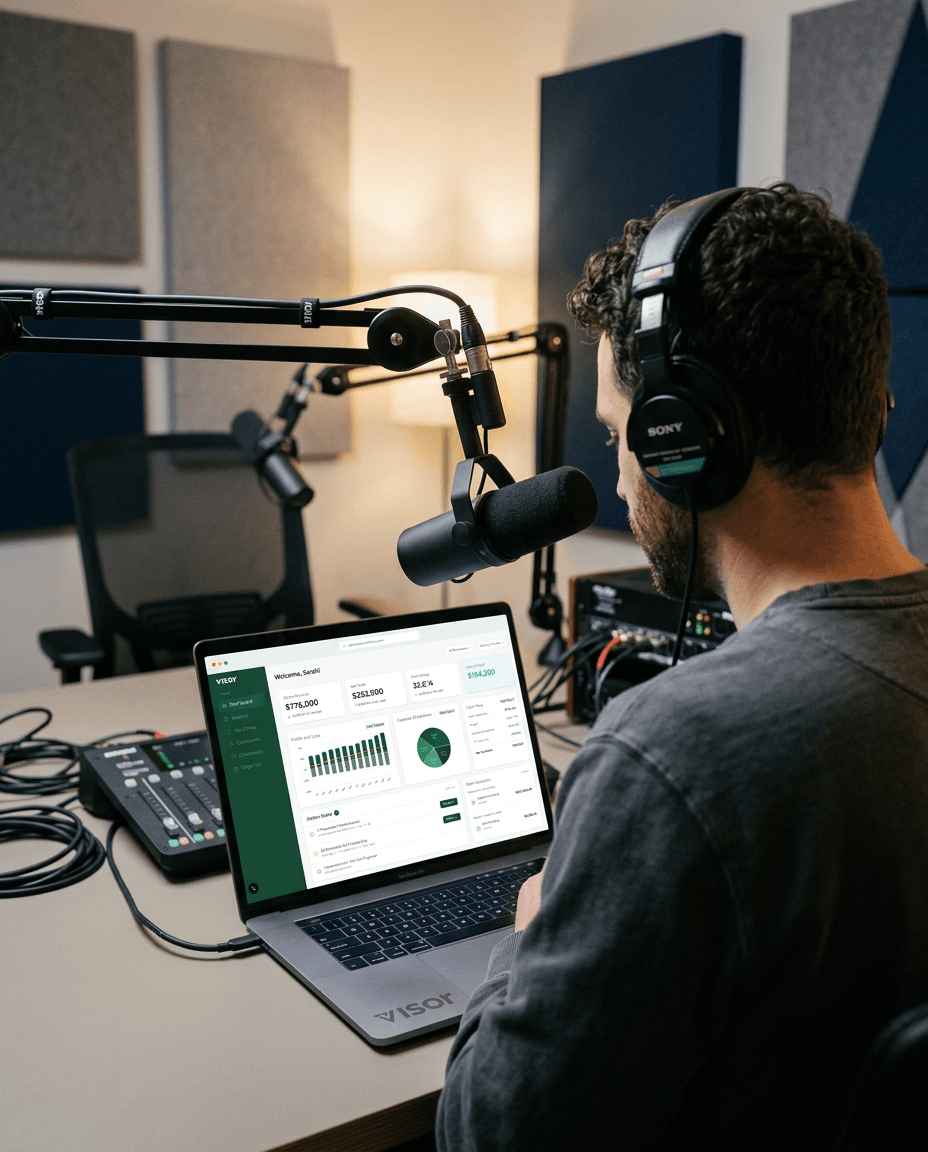
Somewhere in your inbox there's a sponsor payment notification, a Patreon payout and an affiliate report you haven't opened since August.
Podcast income is like that. It trickles in from five directions, in different amounts, on nobody's schedule. Then in March it all lands on one tax return, and you find out what it cost you.
Here's the catch. Many of the moves that lower that bill have to happen by December 31, not when you sit down to file. New gear has to be set up in your studio. Prepaid expenses have to be paid. And if your podcast is set up as an S-Corp, your final payroll of the year has to be right.
The good news is there's still time. Here's what to do with it.
The Short Version
Has to happen by December 31
- Gear and equipment set up and in use
- Prepaying 2027 expenses you want to land on 2026 books
- Final S-Corp payroll
- Solo 401(k) employee deferrals for S-Corp owners
Can wait until tax season
- Choosing between the simplified and regular home office method
- SEP IRA contributions
- Solo 401(k) employer contributions
- Gathering your 1099s and receipts
1. First, Treat Your Podcast Like a Business
Your podcast doesn't need an LLC to be a business. It needs you to run it like one. Everything else on this list depends on that.
If your podcast is a hobby, you still have to report any income it earns. But you can't deduct the expenses¹. Not the mic, not the hosting, not the editor you pay per episode.
If it's a business, those costs become deductions. That's a real difference.
The IRS doesn't use one bright-line test. It looks at the whole picture, including whether you keep complete and accurate books, how much time and effort you put in, and whether you're working to make it profitable². Losses in the startup phase don't automatically disqualify you. An activity is also presumed to be for profit if it made a profit in at least three of the last five years³.
Not every podcast has to be a business. Plenty of great shows are passion projects, and that's a perfectly good reason to make one.
But if you're pitching sponsors, selling a course off the back of your show or building it into your income, run it like a business. Give the show its own bank account, keep real books and save records of what you spent and why.
Once the show brings in real money, the next question is how it's set up.
2. Find Out If Your Show Is Ready to Be an S-Corp
Most of Visor's clients run their businesses as S-Corps. It's one of the biggest tax decisions a growing show can make, and it's the first thing we look at on a call.
How it saves money. As a sole proprietor or single-member LLC, you pay 15.3% self-employment tax⁴ on most of your profit. As an S-Corp, you pay yourself a reasonable salary⁵ through payroll, and payroll taxes apply to that salary. The rest of the profit can come out as distributions, without self-employment tax.
When it makes sense. Our rule of thumb is that an S-Corp starts saving real money at around $80,000 to $100,000 in net profit⁶. Below that, payroll, a separate business return and state fees can cost more than you save.
[CTA inline: Run Your Numbers in the S-Corp Calculator]
Not an S-Corp yet? You'll need an LLC or a corporation first. For an existing business, the election is normally due within 2 months and 15 days of the start of the tax year⁷, which is March 15 for most. But the IRS offers relief for late elections⁸ when you have reasonable cause. Depending on your setup, it may not be too late to make an S-Corp count for 2026, as long as your salary runs through payroll before the year ends. If 2026 doesn't work, the deadline to elect for 2027 is March 15, 2027.
Already an S-Corp? Run your final payroll on purpose. Your salary has to be reasonable for the work you do, and December is your last chance to get the 2026 number right. It's also where retirement deferrals happen, and it affects how much of your profit qualifies for the qualified business income deduction⁹. Your payroll provider's cutoff comes before December 31, so ask for the date now. Once the year closes, you can't redo 2026 payroll. You can plan 2027.
Co-host your show? Two hosts have more options than one shared business. One structure we set up for clients keeps the show as a partnership, with each host owning their share through their own S-Corp. Each host sets their own salary and retirement contributions. If you split a show, ask us about it on your call.
This is the exact topic of our December 1 webinar with Gusto, if you want the full walkthrough. Details are below.
3. Buy the Gear You Were Already Planning to Buy
The camera upgrade. A second mic for in-person guests. Acoustic panels. A new laptop for editing.
If you buy it for the business and it's set up and ready to use by December 31, it can be deducted on your 2026 return. Two rules make this easier than it used to be.
- 100% bonus depreciation is back, and it's permanent. For qualifying property acquired after January 19, 2025, you can deduct the full cost in the year it's placed in service¹⁰ instead of spreading it over several years.
- Smaller items can be expensed outright. Under the de minimis safe harbor, businesses without audited financial statements can elect to deduct tangible property up to $2,500 per item or invoice¹¹. That covers most mics, interfaces and headphones.
The Section 179 limit for 2026 is $2,560,000¹². You will not hit it buying a Shure SM7B.
The catch is "placed in service." Ordered on December 29 and delivered January 4 means it counts for 2027. If timing is tight, buy early enough that it's on your desk and plugged in before New Year's Eve.
Worked example
A sole proprietor in the 22% federal bracket buys $3,000 of gear for the show and has it in use by December 31. That lowers federal income tax by about $660 and self-employment tax by about $420, before any state tax. They still spent $3,000. The deduction softens the cost. It doesn't pay you back.
That's the rule here. Buy what the show actually needs. Don't buy a camera to save on taxes.
4. Prepay the Stuff You Already Pay For
If you use cash accounting, you generally deduct expenses in the year you pay them. That gives you a little room in December.
Under the IRS 12-month rule¹³, you can generally deduct a prepaid expense in the year you pay it, as long as the benefit doesn't extend beyond 12 months after it starts or the end of the following tax year.
For podcasters, that usually looks like:
- Annual plans for your hosting platform, remote recording tool or editing software
- Paying your editor or producer for January episodes in December
- Registering for Podfest Expo, January 14 to 17, 2027¹⁴, before the year ends
Two cautions. Your accounting method has to support this, and if you haven't been using the 12-month rule, starting can count as an accounting method change. And prepaying only helps if you were going to spend the money anyway. If cash is tight going into January, keep it.
5. Account for Every Income Stream (Even the Ones Without a Form)
Podcast money comes from everywhere. Sponsors. Ad networks. Affiliate links. Listener memberships. Merch. Live shows. Speaking gigs that came from the show. Consulting clients who found you on episode 47.
Here's what changed for 2026. For payments made after December 31, 2025, businesses generally only have to file a 1099-NEC if they paid you $2,000 or more¹⁵, up from $600. Payment apps and online marketplaces generally only issue a 1099-K if you received more than $20,000 across more than 200 transactions¹⁶.
That means fewer forms in your mailbox. It does not mean less taxable income. All of it still goes on your return.
Before December 31:
- List every sponsor, network, platform and client that paid you in 2026.
- Match each one to actual deposits in your bank account.
- Chase any unpaid invoices you'd rather collect in 2026, or hold off on billing ones you'd rather push to January.
- Pull out anything personal that landed in your business account, and anything business that landed in your personal one.
If that last step made you wince, you're not alone. Better to find the missing money now than in a letter from the IRS.
6. Claim the Home Studio and the Driving
The home studio. If part of your home is used exclusively and regularly for the business, you may be able to deduct it. The simplified method is $5 per square foot, up to 300 square feet¹⁷, for a maximum of $1,500. The regular method uses your actual home costs and can be larger, with more recordkeeping.
"Exclusively" is the word that matters. A closet you turned into a vocal booth can work. The kitchen table where you record on Tuesdays and eat dinner every night won't.
The driving. Trips to record with guests, to live tapings or to a conference count as business miles. For 2026, the IRS rate is 72.5 cents per mile from January through June and 76 cents per mile from July through December¹⁸. Rebuild your mileage log from your calendar now while you still remember where you went.
7. Open (or Fund) a Retirement Account
This is often the biggest single deduction available to a self-employed podcaster.
For 2026, a Solo 401(k) allows up to $24,500 in employee deferrals¹⁹, plus an $8,000 catch-up if you're 50 or older, or $11,250 if you're 60 to 63. Combined with employer contributions, the total can reach $72,000²⁰ before catch-ups.
The deadlines depend on how your business is set up.
- Sole proprietors and single-member LLCs with no employees. You can adopt a new Solo 401(k) after year-end, by your tax filing deadline without extensions²¹, and still make first-year deferrals for 2026. Opening it in December gives you more time to plan the contribution.
- S-Corp owners. Your employee deferrals come out of your W-2 salary. That means they need to run through payroll before December 31, on the same final run covered in step 2.
- SEP IRA. You can set one up and fund it as late as your filing deadline, including extensions²¹. It's the easiest fallback if December gets away from you.
8. Don't Forget January 15
Your fourth-quarter estimated payment for 2026 is due January 15, 2027²².
If your income jumped this year, the safe harbor rules matter. You generally avoid an underpayment penalty if your withholding and estimates cover at least 90% of your 2026 tax or 100% of your 2025 tax, or 110% if your 2025 AGI was over $150,000²³.
Podcast income is lumpy. One good sponsor quarter can throw off an estimate you set in April. Check the number before January, not after.
Your show earns money from five places. Your accounting should keep up.
Visor is the accounting operating system for independent business owners, including podcasters and creators.
Every income stream, tracked.
Sponsors, platform payouts, affiliates, memberships and products are categorized as they arrive.
Quarterly estimates that move with you.
When a big sponsor quarter lands, your estimates adjust with it.
Tax planning all year, filing at the end.
Your books stay current, so year-end moves like the ones above get planned in time, not discovered in March.
The checklist is the easy part. Knowing which moves are worth it for your show is the hard part.
That's what the call is for. In 30 minutes, we'll look at:
- How your show earns money, and whether it's set up to deduct what it spends
- Which December 31 moves fit your income and your entity
- What your books need before you can act on any of it
You'll leave knowing what to do before the year closes. If Visor's a fit, we'll show you how it works. If not, you still keep the plan.
Gear needs shipping time. Payroll needs a run date. Book now while there's still room to act on what we find.
Podfest Messenger offer: 50% off Visor setup fees.
Book your call by November 27 to get 50% off your Visor setup fees. Mention Podfest when you book.
Get Your Year-End Plan in 30 Minutes
Tell us where your show stands. We'll walk through your income, your setup, and which moves are worth making before December 31. Book by November 27 and get 50% off your Visor setup fees.
Not ready to talk to someone yet?
Join the free year-end webinar on December 1.
You Still Have Time to Make 2026 Tax Moves. But That Window Is Closing.
Tuesday, December 1, 2026 · 1:00 p.m. CST · Live on Zoom · Free · 1 hour
Mitchell Baldridge, CPA, CFP®, and Evan Baldridge, COO of Visor, walk through the year-end moves still on the table, how Q4 payroll affects S-Corp owners, and your December 31 checklist. Hosted with Gusto.
Bring your questions. Attendees get 50% off Visor setup fees too.
Sources
- IRS Publication 529, Miscellaneous Deductions
- IRS, Small Business and Self-Employed FAQs: Income and Expenses
- IRS, Business or Hobby? Answer Has Implications for Deductions
- IRS, Self-Employment Tax (Social Security and Medicare Taxes)
- IRS, S Corporation Compensation and Medical Insurance Issues
- Visor, When an S-Corp Actually Saves You Money
- IRS, Instructions for Form 2553
- IRS, Late Election Relief
- IRS, Qualified Business Income Deduction
- IRS, Treasury and IRS Issue Guidance on the Additional First-Year Depreciation Deduction
- IRS, Tangible Property Final Regulations
- IRS Publication 946, How to Depreciate Property
- IRS Publication 538, Accounting Periods and Methods
- Podfest Expo
- IRS Fact Sheet FS-2025-08
- IRS, Form 1099-K FAQs: General Information
- IRS, Simplified Option for Home Office Deduction
- IRS, Standard Mileage Rates
- IRS, 401(k) Limit Increases to $24,500 for 2026, IRA Limit Increases to $7,500
- IRS, COLA Increases for Dollar Limitations on Benefits and Contributions
- IRS Publication 560, Retirement Plans for Small Business
- IRS Form 1040-ES, Estimated Tax for Individuals
- IRS Publication 505, Tax Withholding and Estimated Tax
This article is general education, not individual tax advice. Tax rules depend on your entity type, accounting method and full financial picture. Figures reflect 2026 IRS guidance as of November 2026.